
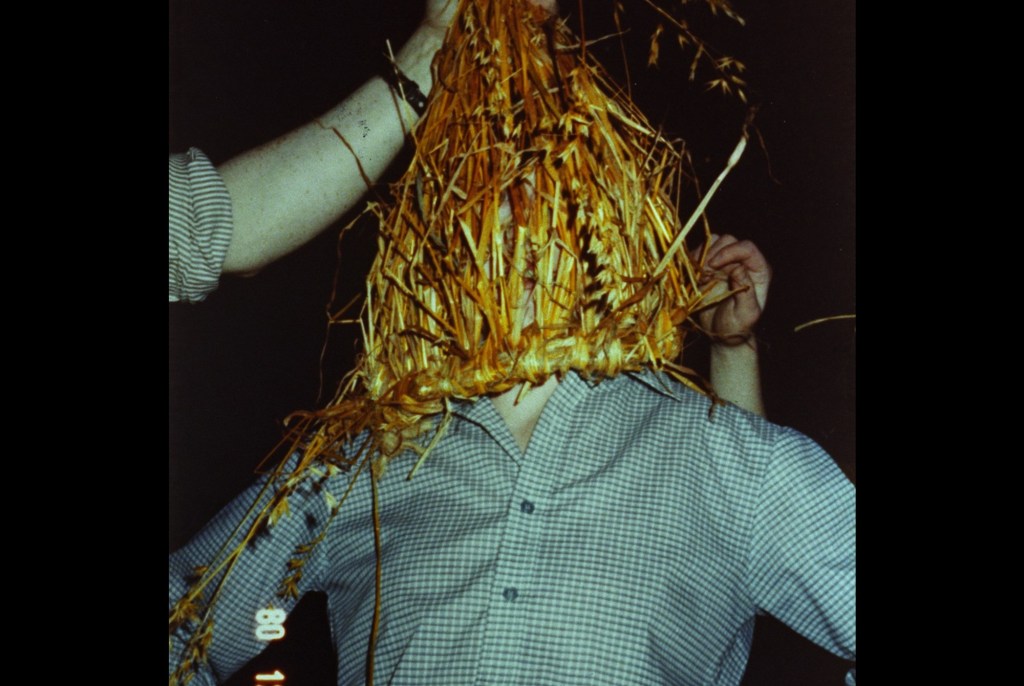
What has a song by Dolly Parton, straw masks, bullying teachers, and kissing arses got to do with teaching myself a new language?
<Link to the audio version of this post coming soon>
Given it’s the season of goodwill to all men, explaining why I’m learning my native language for the first time at this stage of my life is a long history lesson that’s possibly best left for another time. But for the benefit of my Fenian brothers I will be mentioning Kneecap and one or two other radical Irish bands.
Now, as regular readers will know, I was raised in exile in the land of my colonial oppressors. As a result my ‘mother tongue’ is British English – which, even if I do say so myself, I got quite good at. Indeed, most Irish writers got so good at speaking in a tongue that was not their own, that authors and playwrights such as Joyce, Beckett, Bernard Shaw, and wild Oscar are frequently placed in all time Top 10s of Great British writers. There’s even a Orwell Prize winning contemporary of mine, Dónal Ryan, who was born in the same town as me da (my dad), has the same amount of hair as me (none), and now, like me, sports a manly beard to compensate for the lack of the aforementioned hair.
Anyway, let’s put tonsorial tangents to one side for the moment. The point is, I grew up in the English state education system, where the comprehensive school I attended provided me with an education that was neither comprehensive nor an education. Thus, learning Gaeilge (Irish) at school was far from on the cards. So, yet again it falls to me to teach myself new tricks. But given I’ve a Masters in instructed second language acquisition (iSLA) and have taught English at highfalutin places like Imperial College and the University of Nottingham, I should be up to the task, right? Well, my rather lengthy answer to that question is probably also best saved for another time.
So, for now let’s just take a look at a quick snapshot of how this absolute beginner is doing at what I call auto-repatriating his own language.
On Boxing Day Kneecap shared a rather striking photo of two masked figures. Above the image was a five word phrase.
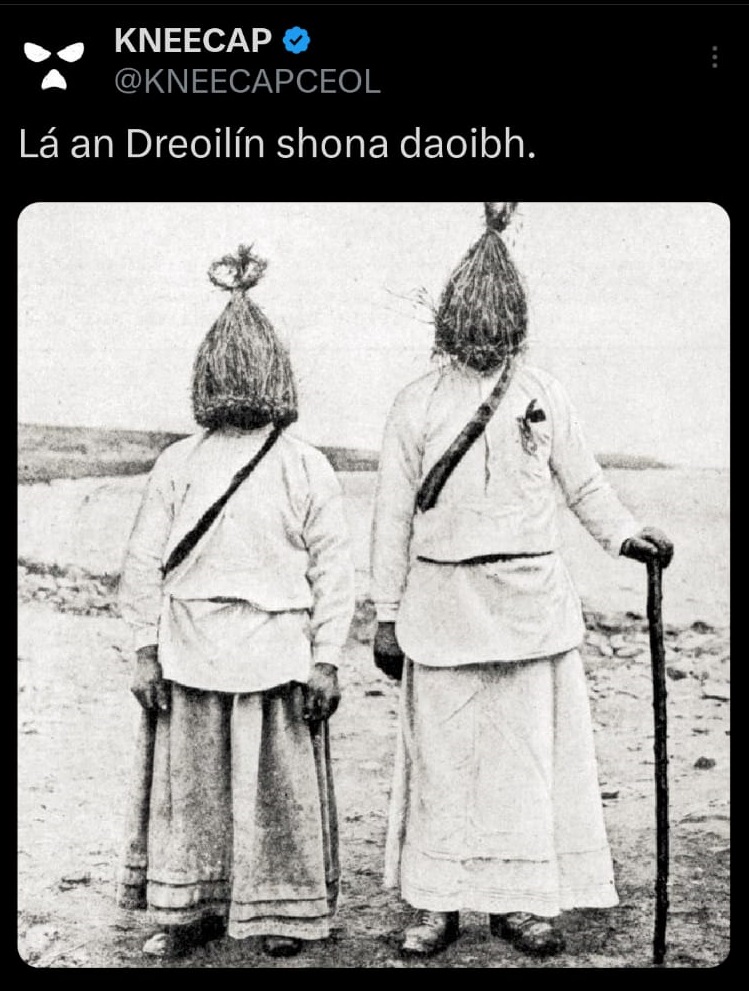
Of the words in the short phrase that accompanied the image there was only one piece of vocabulary I hadn’t encountered before. Not encountering it before means I didn’t know how to pronounce it so I won’t type it out here just yet so that (even if you’re listening to audio version of this post) you can follow my process of using contextual clues and intercultural knowledge to acquire it.
The word in question is the third or middlemost word in the five word phrase. The word ends in the letters “í” “n”. The í you’ll notice has an accent (or fada). The fada over the í (and over the ó in Dónal) is a diacritic mark that tells us the vowel is a long vowel. So in my name the Dó in Dónal sounds more like the dough in doughnut than it does the Don in Donald Duck. Which if you’re listening to this you already know.
I have a sister called Roisín, and just like the word in question her name also terminates in this i fada n sound. You’ll be pleased to know that I do know how to pronounce not only my own name but also my sister’s name correctly. Alas, I mean shamefully, back in the 80s when my sister and I were at school, the teachers would deliberately mispronounce our names as punishment for the crime of… I don’t actually know what we’d done wrong; having Irish names, introducing ourselves by pronouncing our names correctly? Or perhaps there was no motive beyond bullying behaviour stemming racial prejudice. There’s even historical case of a Dónal being fined by the British occupiers for using the Irish spelling of his name on the cart from which he sold farm produce. I believe another Irish chap from the same era but with another name and a different handcart was either whipped, hung or shot for commiting a similar “offence”.
Sadly, this sort of behaviour has not been confined to the history books. Only this year, the teacher of a writing course I was taking took umbrage at me for having the termity to spell my name correctly. He knew how to pronounce it, but would occasionally for no apparent reason pretend the fada had confused him, he’d “comically” mispronounce Dónal in several different ways and then look around the room for approval – thankfully most of my classmates (the majority of whom were not English) looked back at him with blank or confused expressions (perhaps thinking to themselves ‘this British humour is very tricky to get the hang of’) and he eventually stopped doing it.
His name? Well, let’s just call him Mr Poor Craic or Mr Cráic Mor (Mr Big Arse). Indeed, cráic with a fada is a very different word to craic without the fada. Yes, adding a fada to your name is more than pedantry, it has a purpose. It makes a difference to both sound and meaning. The fada is the fine line between being fun (craic) and being an arse (cráic).
Now back to the ín in Roisín and the unknown third word in the Kneecap photo. The ín in Roisín sounds like the een in been. Which if you’re listening to this you already know. Well, I must have heard and uttered the phoneme ín millions of times in my two score years and ten. Yet it took a recent Roisín to explain its lexicogrammatical significance to me.
I met two Roisín’s this summer while I was down in Kernow (or Cornwall in British English – but again, that’s a story for another time). One of the Roisíns I met explained that ín is a diminutive suffix. Now, I knew what a diminutive suffix is (we have them in English e.g. booklet, a little book) but unbeknownst to me, this one had been staring me in the face in not just my sister’s name (Roisín, little Rose) but also in some of Irish words that have found their way into everyday in English.
For example, the spirit poteen (poitín, Irish moonshine) is a little drink with a big punch. And if your illicit whiskey still explodes when you’re nearby, it might blow you to smithereens (smidiríní – tiny pieces).
Oh, does that mean the suffix íní signifies small things plural? Good question. But remember, I’m the learner not the teacher. What you’re reading here is not Irish but interlanguage. It is an idiolect that is unique to me. The interlanguage I’m expressing here is my current understanding of Irish (which is currently at the level of village idiot). That means there will be many errors and omissions in this self-taught lesson.
With that caveat mind, I’m reminded that I do know a cúpla focal (a few words) more than the focal Irish my aged brain has tricked me into believing I have. Now, if you’re listening to this rather than reading it, that second fuck all was not an expletive but a poor pun on the Irish word for word (focal).
Speaking of puns and wordplay, my dad taught me my first bilingual joke. He would play it on posh people at dinner parties when they asked him how he says cheers in Irish. He would clink their glasses and say “Cathaoireacha!”. Now, if you pronounce cheers in your best poshest accent, my late father has just taught you how to say chairs as Gaeilge (in Irish). And if you want to thank the ghost of my father for that mini-language lesson, you can raise your glass and say “Sláinte!” (sounds like slawn-cha).
Sláinte, Terry! Could you possibly tell your son that he’s forgotten to answer my teeny weeny íní suffix question.
I haven’t forgotten. Trust me. Even though this might seem like an ad libbed stream of consciousness, this nonsense is carefully planned. Take a look at the map. This is a Christmas episode/blog post in which we’ve covered Irish words we didn’t know we knew, we’ve sprinkled in some bilingual wordplay, drinking vocabulary, and arse slash crack, which brings us to… that’s right, one of the most played Christmas songs of the 21st Century!
At this time of the year Shane MacGowan and Kirsty McColl’s Fairytale of New York will be ringing out all over the airwaves. Shane MacGowan (Rest in Pub) passed away just three Christmases ago. His state funeral was held at the same church in Nenagh I would be dragged to on our family holidays to Ireland when I was a child. Shane MacGowan as you know was the lead singer of the Pogues.
The Pogues were briefly known as Pogue Mahone, which is an anglicisation of the mock salutation/slash insult póg mo thóin (kiss my arse).
Which brings us to your insightful question about the possibility of a small things plural suffix.
Well, if póg is a kiss, then pógín is a… pregnant pause for the listeners
line break slash carriage return for the readers
…that’s right well done! A pógín is a little kiss.
So it follows that pógíní are, no pause this time, little kisses.
Now, I’m dying to tell you about pluralia tantum (plural only words) for small things such as toe-nail scissors or a bikini. But since this a family show, it’s fortunate that there isn’t time to talk about how the bicíní, when spelt in Irish with it’s íní suffix makes more sense for a word that comes from much warmer climes and means ‘place of coconuts’.
OK, now where are we with respect to the unknown (and now probably forgotten) word in the Kneecap phrase. Admittedly, we’re not getting very far, but in my defence that last diversion was your fault.
So, at about a two thousand words and 20 minutes in, whatta we know so far about this unknown word?
It ends in the sound ín, which signifies whatever it is it’s likely a singular entity and a small one at that. But what could it be? What contextual clues can we use to divine the meaning of this word?
Well, let’s play Blankety Blank and take a look at its neighbours. But before we do that, notice how, conscious of time, I’ve refrained from telling you that this BBC Television word game was hosted by Terry Wogan, a fine man from Tipp who shares his county of birth (Tipperary) and his first name (Terence) with me dad. If I did that, it’d probably lead to a longer diversion featuring the GAA and an Irish relation of mine being responsible for Churchill winning Second World War.
I know the first word in the phrase lá, means ‘day’. I know this for two reasons. I first came across it in the phrase tiocfaidh ár lá. Most Irish, even if they don’t speak a word of Gaeilge, have an understanding of the meaning of this phrase. They may not be able to translate it word of word but the collective inheritance of their DNA allows them to understand its sentiment. I’ll leave you to google (or if you’re worried about Starmer’s snooping, duck duck go) it for yourself. Lá is also present in the phrase Gaeilge Gach Lá, which means Irish Every Day, and is a wonderful online resource for making sure you are responsible for learning a little more Irish each day.
Given that it’s Christmas time, many a beginner Gaeilgeoir (Irish speaker) like myself will have swotted up on their seasonal greetings as Gaeilge (in Irish), e.g. Nollaig Shona Duit (Happy Christmas [to you]) and Nollaig Shona Daoibh (Happy Christmas [to yous]). That daoibh there is interesting as British English doesn’t have you in a plural form for when there is more than one person in the group you are addressing. Again this would be to start another tangent, but Hiberno-English does have a second person plural pronoun. Hence “Hello, how are yees” and “Have yous not arrived yet?“. But it’s interesting to note that the D can sound like a “jer” sometimes, jeeve (daoibh).
So, Lá an Blankety-blank shona daoibh is a seasonal greeting for a specific day (lá). Rearranging that into British English we get “Happy Day of the Blankety-blank to Yous”. Could our unknown word mean Boxing Day? Afterall, the photo and accompanying phrase was shared on Boxing Day. Well, such a diversion would be a wrong turn. The photo is a big contextual clue and I vaguely remember my late mother once telling me about an Irish tradition of dressing in masks and “hunting” something. The details are a little hazy, so I’m going to use the magic of the internet to remind myself and I’ll be right back.
Well,that was interesting. Here’s a very of abridged version of what the internet has to say about it:
Boxing Day is also known as St. Stephen’s Day. St. Stephen was locked up because the new religion he was preaching was considered blasphemous by the adherents of slightly less new and shiny religion. When he was sneaking out of jail he disturbed a wren. Then wren’s distress song alerted the guards and Stephen was recaptured and stoned to death. In Christian lore, the little wretch of a wren is considered to represent the devil. When Christianity spread throughout Europe it mapped itself onto a pre-existing calendar of pagan feasts, festivals, and traditions. In Ireland the diminutive wren was seen as having notions – it somehow became the king of the birds, lording it over the eagle no less. Having notions is generally looked down upon in Ireland, and the wren came to embody an evil spirit and a harbinger of bad luck. Around the time of the winter solstice the Wren Boys (gangs of masked lads with sticks) would perform the service of ridding your property of these wretched wrens, thus ensuring prosperity and good luck to you and your household for the coming year. In a very similar transaction to bob nó bia (trick or treat – which the Irish invented long before modern day Halloween), you were then obliged to pay for this service (even though the service the Wren Boys was offering was not optional) or else they might bury the bird in your garden leaving your year tainted with a terrible curse. And thus, the tradition of Wren’s Day was born.
So, the missing word in the phrase is wren or Jolene (well that’s what it sounds like to me in the Connacht and Munster dialects). Lá an Dreoilín Shona Daoibh (Happy Wren’s Day). In British comprehensive state school English Jolene was a bootiful bird innit. Dolly Parton was concerned that Jolene would steal her man leading to a betrayal in the same way that a pretty little wren betrayed St. Stephen. Is Dolly Parton perhaps Irish? Her maternal grandmother was a Dunn, so quite possibly so. Was the choice of Jolene as the antagonist in the eponymous song clever word play on Parton’s part or a the result of a subliminal visit from her muse? Well, that is another partially made up story that’s best left for another time.
If this episode of Oh Dónal’s Dictionary has inspired you to tune in to the sounds and sense of Irish, I’ll leave you with a better teacher than me. As a beginner Gaeilgeoir, you can’t go far wrong than listening to Chasing Abbey. An Irish trad-house band that sing in Irish and English, and whose videos have bilingual subtitles.
Slán go fóill (That’s all folks!)

 Donal Fogarty
Leave a comment